Monday

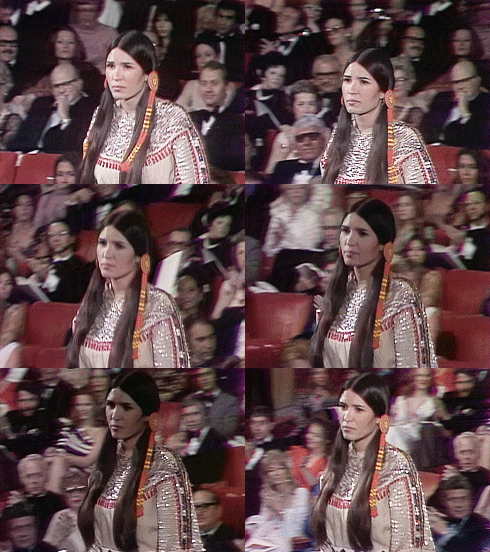
Marie Louise Cruz was born in 1946 to a white mother and a father of Apache, Yaqui and Pueblo descent. After high school, she took the name Sacheen Littlefeather to reflect her Native American heritage.

 Soon thereafter, she became an activist for Native American rights. She joined the organization Indians of All Tribes, and participated in the group’s spectacular 19-month occupation of Alcatraz Island to protest the mistreatment of Native Americans by the U.S. government. The protest, which lasted from November 1969 to June 1971, garnered widespread sympathy and was visited and supported by celebrities including Marlon Brando.

In February 1973, another group, the American Indian Movement, staged an occupation of Wounded Knee, South Dakota, the site of a brutal 1890 massacre of hundreds of Lakota men, women and children, to protest corruption and the failure of the government to honor treaties with Native American tribes. Meanwhile, the Academy Awards had nominated Marlon Brando for Best Actor for his role in The Godfather. The actor had become a more vocal supporter of the movement for Native American rights.

Hoping to direct attention to the ongoing protest in Wounded Knee and the misrepresentation of Native Americans in Hollywood, Brando asked Littlefeather, who had recently begun an acting career, to appear in his place at the Academy Awards on March 27.


Littlefeather arrived at the ceremony dressed in traditional Apache attire, carrying a 15-page speech written by Brando. Backstage, a producer confronted her and threatened to have her forcibly removed and arrested if she spoke for more than a minute.

When Brando’s win was announced, she stepped to the stage and declined to accept the statuette offered by presenter Roger Moore.Her improvised remarks outlining the reason for Brando’s refusal were met with a smattering of boos, which were then drowned out by supportive applause.


After leaving the stage, she read the entire lengthy speech to the assembled press. The act refocused public attention on the siege at Wounded Knee, and possibly staved off more deadly military intervention. Littlefeather continued to act in films and organize in the Native American community.


"I beg at this time that I have not intruded on this evening, and that we will, in the future, our hearts and our understandings will meet with love and generosity." Sacheen Littlefeather
Source




This little fluffy ball of joy can do no wrong. Every time he gives his humans that pitiful look often coupled with a meerkat impression, no one in the family has the heart to say no, ever!

Soon after he moved into his new home, he stood on his hind quarters and hid his front paws in his ever so fuzzy coat while looking into the eyes of his humans. Whatever he asked, he got!

The Scottish Fold is a breed of domestic cat with a natural dominant-gene mutation that affects cartilage throughout the body, causing the ears to "fold", bending forward and down towards the front of their head, which gives the cat what is often described as an "owl-like" appearance.

Originally called lop-eared or lops after the lop-eared rabbit, Scottish Fold became the breed's name in 1966. Depending on registries, longhaired Scottish Folds are varyingly known as Highland Fold, Scottish Fold Longhair, Longhair Fold and Coupari.

Scottish Folds, whether with folded ears or with normal ears, are typically good-natured and placid and adjust to other animals within a household extremely well. They tend to become very attached to their human caregivers and are by nature quite affectionate. Folds also receive high marks for playfulness, grooming and intelligence. These animals like to be outdoors and enjoy outdoor games and activities very much. Loneliness is something they heavily dislike and which makes them feel depressed.It is also common for Scottish Folds to be stubborn.
Via Lovemeow.com

Photos: Instagram


A video posted by bellcat (@1room1cat) on

Leonardo DiCaprio used his Oscars speech to address climate change. He urged the audience to “support leaders around the world who do not speak for the big polluters or the big corporations but who speak for all of humanity, for the indigenous people of the world, for the billions and billions of underprivileged people who’ll be affected by this”.

"Making The Revenant was about man's relationship to the natural world, a world that we collectively felt in 2015 as the hottest year in recorded history. Our production had to move to the southern tip of this planet just to find now. Climate change is real. It is happening right now. It is the most urgent threat facing our entire species and we need to work collectively together and stop procrastinating.

We need to support leaders around the world who do not speak for the big polluters or the big corporations, but who speak for all of humanity, for the indigenous people of the world, for the billions and billions of under privileged people who will be most affected by this, for our children's children, and for those people out there whose voices have been drowned out by the politics of greed.

I thank you all for this amazing award tonight. Let us not take this planet for granted, I do not take this night for granted. Thank you so much."


At long last, 41-year-old actor Leonardo DiCaprio has grasped his hands around one of those Oscars, and, as well as thanking everyone who helped him get it, he used the moment to talk about the serious issue of climate change.
Source 

Photo Via Indigenous Today

VIDEO
Oscars: Leonardo DiCaprio Wins Best Actor for 'The Revenant'
It's official! Leo is taking home his first Oscar. Upon accepting, The Revenant Movie star said, "Let us not take this planet for granted. I do not take this night for granted." #Oscars
Posted by The Hollywood Reporter on Sunday, February 28, 2016

Wolverines are famous for their solitary nature, but a wildlife photographer recently captured a surprisingly tender moment between one wolverine and her child.

 While making his documentary Wolverine: Ghost of the Northern Forest, Andrew Manske filmed a wolverine mom carefully carrying a tiny kit in her mouth to a new den. According to Manske, the footage represents the first time a baby wolverine has been seen in the wild.

The filmmaker called the clip the highlight of his career, the result of five frigid winters spent following the notoriously elusive animals in the Canadian north.

"We were shocked to see her come out in the middle of the day," Manske told the CBC.

It was the behavior of male wolverines, however, that ended up surprising Manske and wildlife researchers alike.

"We started learning that male wolverines might play a bigger role in raising their young," said Manske. "The male would come by every couple days just to check on them."


Andrew Manske captured what he believes is a world first – footage of wild wolverine kits. Their mother carries the pale grey, squealing, fluffy bundles outside the den while moving them to a new location in broad daylight.
Source


VIDEO
Wolverine: Ghost of the Northern Forest - Baby Wolverine
WATCH THURSDAY AT 8 PM OR ONLINE: A wild baby wolverine. This is the first time this scene has EVER been caught on camera. For more on the secret lives of these small but mighty animals: http://www.cbc.ca/natureofthings/episodes/wolverine-ghost-of-the-northern-forest
Posted by CBC Docs on Thursday, February 25, 2016

Sunday

A sweat lodge on Fort Carson is leading the way for military installations around the United States. The centuries-old Native American tradition has become a new form of treatment for soldiers suffering from Post-Traumatic Stress Disorder (PTSD).

 What once was a ritual held in secrecy is now a growing trend among both active duty and veteran warriors seeking its legendary cleansing powers. In a remote section of Turkey Creek, the air is filled with songs and smoke at the Lakota Sioux inipi, a traditional sweat lodge made of willow branches and donated quilts.

The sweat lodge has been there since 1995.

Hackwith, a Marine veteran of the Gulf War, started the inipi with a couple friends who wanted to follow their own cultural religious practice. They got permission from the manager of the Turkey Creek ranch at the time. The participants pray, sing, play drums and sweat in the tent around dozens of hot stones, in complete darkness. It is a purity ritual designed to help sweat out negativity, a common problem for struggling soldiers.

Special Agent Kevin Cheek of the Air Force, now the military liaison for the sweat lodge, says, “I’ve deployed five times. I’ve been there and back, and all that negative baggage that you collect and the things that you see and stuff like that, this helps you cope. This helps you deal with all that.”


Fort Carson formally recognized the sweat lodge as a religious practice in 2005, the first ever on a military base. Chaplains now recommend the ritual to those with PTSD. Guided by natives belting out tribal chants, everyone else is encouraged to pray in their own faith.

“You pray for your enemies and people that don’t like you,” explains Cheek. “And that’s difficult, and as a veteran, you’re praying for those people that actually shot at you. That helps you come to terms with a lot of the stuff.”


Now rocks provide an escape. The stones heat over open flames for hours before being passed into the sweat lodge, where leaders pour sage and water over them to produce the steam.

Originally designated only for men of the tribe, leaders now welcome anyone to the lodge, especially soldiers. Women and men sit on opposite sides of the lodge, which seats up to 40 participants. Women wear loose cotton garb, while men wear shorts. After four rounds of sweating, the participants share a pipe filled with willow bark and eat ceremonial dishes that represent different aspects of life.


The leaders hope the tradition will continue for generations to come. Spiritual leader Wesley Black Elk says, “There’s not a whole lot of Native Americans left in this country, and the sad truth is someday we’ll be gone, and this is all they have to remember us by.”

You can now find sweat lodges at a few other military bases and Veterans Affairs centers around the country.
Source

VIDEO
Veterans Using Native American Rituals To Treat PTSD

Veterans are treating their PTSD at Native American sweat lodges

Posted by NowThis on Tuesday, February 16, 2016

In the midst of a well-warranted controversy about the lack of diversity in Hollywood, here are 10 Native actors and films that should have ‘snagged’ an Oscar.

Evan Adams as Thomas Builds-The-Fire in Smoke Signals

Perhaps no other acting performance in recent decades has delivered such raw honesty as Evan Adams’ portrayal of Thomas Builds-The-Fire in Smoke Signals.

Director Chris Eyre has said in interviews that when he asked Evan Adams what he was doing during his performance, Adams said he was channeling the spirit of his own grandmother. He deserved an Oscar just for bringing “Hey Victor” to Indian Country.

Much like the simple straightforwardness of Evan Adams, Irene Bedard also brought a shining light to Chris Eyre’s Smoke Signals as Suzy Song. A bit of friendliness and a bit of mystery from Bedard brought Suzy Song to life and should have drawn a nod from the Academy.


Gary Farmer’s portrayal of an abusive husband and father Arnold Joseph was gritty, real and certainly deserved the coveted gold statue. Not to mention a big Oscar nod was due to Chris Eyre for directing the film.

 Evan Adams as Thomas Builds-The-Fire in Smoke Signals


Best Film: Pow Wow Highway This classic film, which was directed by Jonathan Wacks and starred Gary Farmer and A Martinez, should have a little golden man on its mantel.


Tantoo Cardinal in Smoke Signals… and everything else she’s done
Tantoo Cardinal has been bringing beautiful acting to the silver screen for decades. As a brilliant First Nations actress, it is a downright shame that a woman who has been honored as a Member of the Order of Canada, one of Canada's highest civilian awards, recognized for her contributions to the growth and development of Aboriginal performing arts - has never even been nominated by the Academy.


Honorable Mention for Native Film: Bury My Heart At Wounded Knee With a handful of Golden Globe nominations, Emmy awards and a huge helping of other awards and nominations, this non-commercial TV movie, Bury My Heart At Wounded Knee, should have been booked in a theater for a week to receive a well-deserved Oscar.


Best Documentary: Reel Injun With an all-inclusive and comprehensive look at Native Americans in film, Cree filmmaker Neil Diamond exposes the film industry’s stereotypical portrayal of Native people since the inception of moving images. This film which snubbed the Oscars, should have been given one.


Best Film / Best Actress: Kimberly Guerrero in The Cherokee Word for Water Based on the work to provide clean water for her people, The Cherokee Word for Water portrays Kimberly Guerrero as Wilma Mankiller, the woman who would become the first modern female Chief of the Cherokee Nation. With a 2014 Western Heritage Award, the film and Guerrero deserved the Oscar nod.


Will Sampson in One Flew Over the Cuckoo’s Nest Perhaps one of the most disregarded and talented Native American actors is Will Sampson, who was constantly overlooked on such films as The Outlaw Josey wales, The White Buffalo and much more. His performance as Chief Bromden in “One Flew Over the Cuckoo’s Nest” alongside Jack Nicholson is one of the most iconic acting performances in film history.


Wes Studi in The Only Good Indian Wes Studi portrays ‘Sam’ in a The Only Good Indian, a movie set in Kansas during the early 1900s, in which a teen-aged Native American kid (Winter Fox Frank) is taken from his family and forced to attend a distant Indian boarding school to assimilate into white society. Studi did an awesome job in Avatar too, but didn’t get an Oscar nod for that, either.


Adam Beach in Flags of Our Fathers Though he has been nominated for a Golden Globe for Bury My Heart at Wounded Knee, Adam Beach was seriously robbed for his stellar performance in this film, in which he portrayed Ira Hayes.
 Source
Article Indian Country Today by Vincent Schilling
 

Marty was one of 31 malnourished and neglected Alaskan malamutes found in a home last summer. He was taken in by a rescue organization in Michigan that nursed him back to health. He returned to Durham this week to live with the deputy who saved him

Sheriff’s deputy Dakota Beck of the Durham Animal Services Division deals with dogs every day in her professional life. But Marty was the first one she brought home.

 Last July, Beck found the dog caged in a home crammed with 30 other Alaskan malamutes, a breed similar to huskies, that were all malnourished and covered in their own excrement. “He literally jumped up and hugged me,” said Beck. “And that’s when he melted my heart.”

After months of rehabilitation and multiple surgeries in Michigan, Marty was reunited this week with the officer who helped save him seven months earlier.

The story began with a call about a husky running loose on Sybil Drive on the east side of Durham, which led Beck to a home with a horrible smell lingering on the front porch. Through the window, she saw dozens of sickly dogs in cages – some whimpering, others unresponsive. Beck obtained a warrant to seize the dogs, and a crew from animal services stayed up all night transporting them to the Animal Protection Society of Durham.


The dogs were immediately treated for malnutrition, dehydration and burns from the urine that covered them. The woman hoarding the malamutes, Sandra Lehto, was charged with 28 counts of animal cruelty and barred from owning animals.


After the rescue, calls flooded in to offer the dogs new homes, and all the dogs were places with rescue groups or families. Marty was sent to The Southwest Michigan Husky Club to be rehabilitated.


“Marty was kind of like a toasted marshmallow. Rough on the outside, but soft on the inside,” said Suzanne Sarlls-Hartwell, president of the organization. “We knew he was going to be hard to place because he was older.”
Source


VIDEO

Saturday

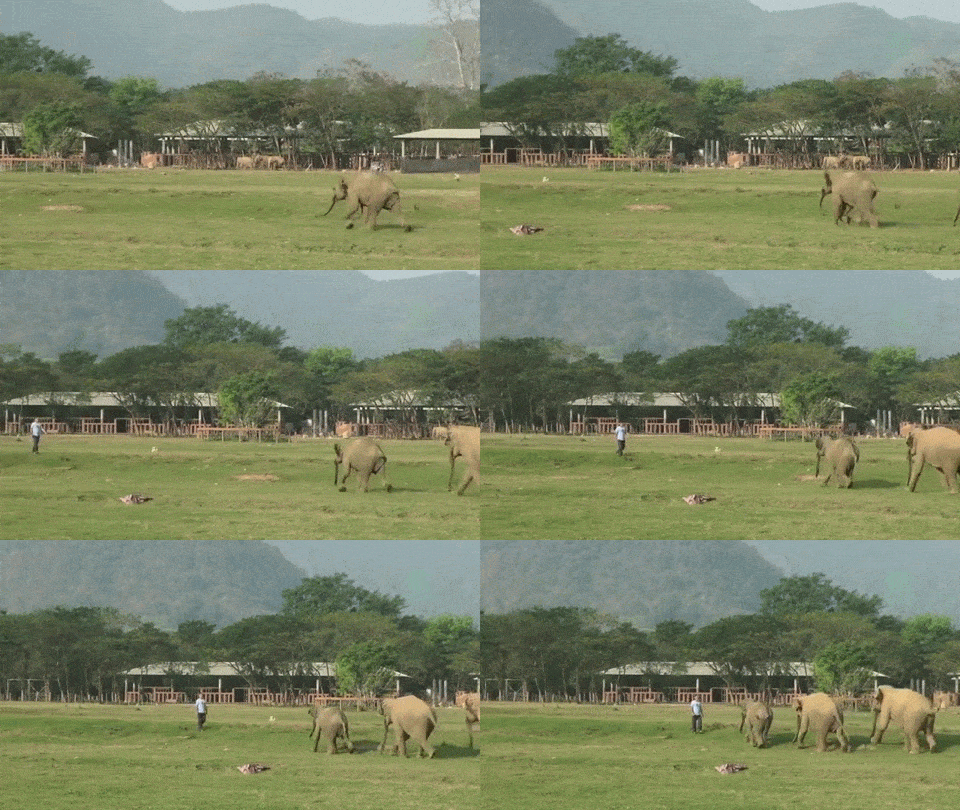
When Darrick, a caretaker at Elephant Nature Park, calls out to Kham Laa the friendly elephant, she runs right over just like a happy puppy! Well, a giant, lumbering puppy – maybe…

While it might seem surprising that she is so eager to see Darrick, elephants are actually very social beings and form deep bonds with others, just like humans do. These incredible creatures have been known to show love and empathy for one another – and studies have even found that they are capable of discerning between kind humans and ones who wish to do them harm. How about that!

With this in mind, we can tell that Kham Laa must really love her human caretaker based on how quickly she sprints up to him.

Before coming to Elephant Nature Park, Kham Laa most likely spent her life in the tourism industry. Thankfully, she no longer has to live a traumatic life in captivity, now she gets to spend her days with her family and human BFFs!


Of all the creature of the world none mirrors the life term of man as the elephant. Living to the ripe old age of 70 years they mature in a very similar way as that of human beings. The main difference is actually before they are born. The mother is pregnant for just short of two years before the baby arrives.
Source


VIDEO


Yhi the wombat may still be only a baby, but she's got an important job to do. Admittedly though, it's something nobody asked for. Rather, she assigned herself.

In a sweet new video from the Sleepy Burrows Wombat Sanctuary in Australia, we see Yhi eagerly lending her tiny choppers to help a dog named Stella tend to an itch. Stella, meanwhile, appears more than capable of completing the task without assistance.

Still, she has the utmost patience for the wombat apprentice, and even gives Yhi kisses as a reward for her effort.

This little arrangement between Stella and Yhi is about much more than just being cute. Dogs at the sanctuary play an important role for the rescued wombats, keeping them safe and cared for just like the human members of the team.


Sleepy Burrows Wombat Sanctuary work includes relocating wombats, assisting councils and farmers, educating children and people in general about wombats. Encouraging co-existence in our ever changing world which is dominating their habitat in a very serious way.

 VIDEO
Wombat joey Yhi and wombat guardian dog Stella
Wombat joey Yhi assisting Stella with her grooming .....sort of (watch when Yhi gets her tongue:)). Remember, Stella guards the wombats, that is what she is bred to do so she is with them from a very young age, protecting and looking after them.
Posted by Sleepy Burrows Wombat Sanctuary on Wednesday, February 24, 2016

Friday

The Shoshone-Bannock Tribes are located on the Fort Hall Reservation in Southeastern Idaho, between the cities of Pocatello, American Falls, and Blackfoot. The Reservation is divided into five districts: Fort Hall, Lincoln Creek, Ross Fork, Gibson, and Bannock Creek. Currently, 97% of the Reservation lands are owned by the Tribes and individual Indian ownership.

 The Tribes are composed of several Shoshone and Bannock bands that were forced to the Fort Hall Reservation, which eventually became the Shoshone-Bannock Tribes. There are approximately 5,681 enrolled tribal members with a majority living on or near the Fort Hall Reservation.

Through its self-governing rights afforded under the Fort Bridger Treaty of 1868 and the Indian Reorganization Act of 1934, the Tribes manages its own schools, post office, grocery store, waste disposal, agriculture and commercial businesses, rural transits, and more.

In 2012, the Language and Cultural Heritage Department initiated an ongoing holistic language preservation project and are collecting oral histories from tribal elders which are then transcribed and translated into written documents and preserved as audio archives. They are also developing language curricula for school classrooms and teach language classes on a regular basis.


VIDEO

Native American Child's Song
Shoshone Bannock mother sings a song in her traditional language to her young son
Posted by Native Pictures on Tuesday, April 3, 2012

He might be almost 121 in cat years, but the world's oldest moggy has proved its never too late to get to grips with social media.

At 26 years old, pet cat Corduroy, who lives in Sisters, Oregon, has racked up thousands of followers after his owners set up his very own Instagram, Facebook and Snapchat accounts.

Fans log on daily to to keep up-to-date with the elderly animal, who holds the Guinness World Records title for the oldest living cat and is still in remarkable good health. Owner Ashley Reed Okura, 34, said: 'I set up Corduroy's Instagram account on August 13 last year - the same day Guinness World Records graciously announced his claim to the record of the oldest living cat.

'He also has Snapchat and Facebook and the reaction has been really positive. 'I do my best to update his followers and respond to messages and special requests.' 'I strongly believe the key to his longevity is the fact we did not declaw him and allowed him to go outside.


'He was able to defend himself and exercise his body and mind by hunting. Corduroy still catches critters but is not as good as he once was, thankfully.' The owner added that Corduroy has a mellow personality and loves to groom himself, be petted and cuddled, take catnaps in the sun and play with catnip-filled mice and a pheasant feather.


She believes he knows he is special because he enjoys the attention he gets from friends and family, and is patient with young visitors. She added: 'It is an honour to have Corduroy in our life, I honestly don't remember much of my life without him. 'He is a wonderful companion and I hope to give him a happy and healthy life for many more years.'
Source


VIDEO

Stats

Archives

Pages